In traditional MPLS networks running RSVP-TE, protecting every LSP against link and node failures requires manually pre-configuring bypass tunnels for each potential failure scenario. In a network with dozens of nodes, this means hundreds of manually engineered tunnels, each requiring careful path specification, ongoing maintenance as the topology changes, and operational expertise to troubleshoot when something goes wrong.
RSVP Auto Bypass solves this problem. OcNOS dynamically discovers protected LSPs traversing each interface, automatically creates the optimal bypass tunnel for each failure scenario, and maintains these tunnels as the network topology evolves. The result is fast reroute coverage without a single manually configured bypass tunnel.
How RSVP Auto Bypass Works
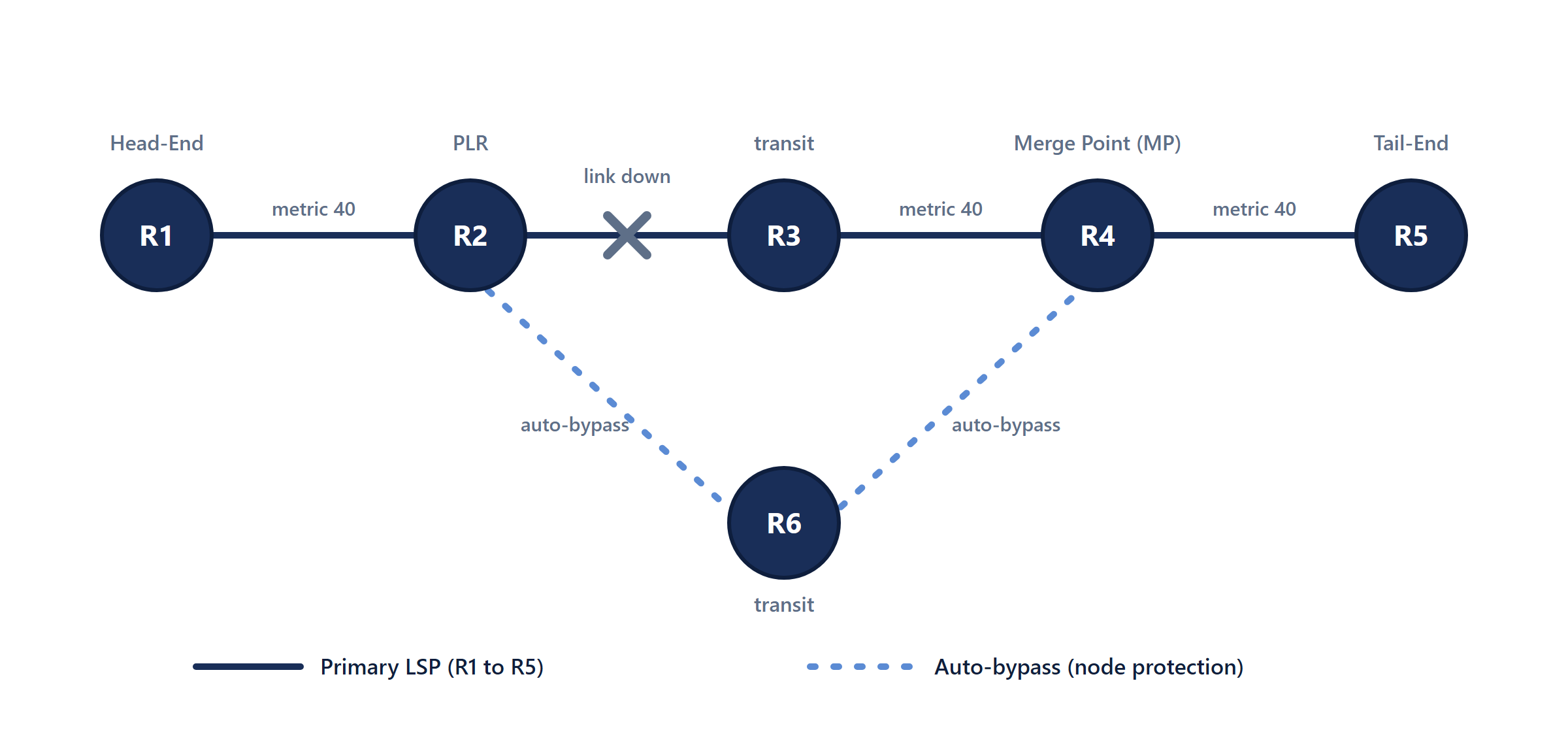
Configuring RSVP Auto Bypass on OcNOS
On OcNOS, RSVP-TE uses the rsvp-path 和 rsvp-trunk model rather than tunnel interfaces. The head-end signals the primary LSP and requests facility (bypass) protection; each transit node then only has to enable Auto Bypass, and OcNOS discovers every protected LSP crossing that node and builds the bypass trunks automatically.
! OcNOS -- Head-end (R1): primary RSVP-TE LSP requesting facility fast-reroute.
! The explicit path pins each hop; the trunk requests facility (bypass) protection.
!
rsvp-path R1-R5-PRI-PATH-001 mpls
 51.51.1.2 strict
 52.52.2.4 strict
 53.53.3.5 strict
 54.54.4.4 strict
!
!
!
rsvp-trunk R1-R5-PRI-TR-001 ipv4
 primary fast-reroute protection facility
 primary path R1-R5-PRI-PATH-001
 from 20.0.1.0
 to 20.0.5.0
!! OcNOS -- Transit / PLR (R2): enable RSVP Auto Bypass.
! This is the only bypass configuration the PLR needs. OcNOS then discovers every
! protected LSP crossing the node and builds bypass trunks automatically.
!
R2#show running-config rsvp
!
router rsvp
auto-bypass
enable
exit
!Verification Commands
! OcNOS -- RSVP Auto Bypass verification (operational status)

! 1) Head-end (R1): forwarding entry for the protected FEC (20.0.5.0/32).
!    Code R(t) = RSVP-TE tunnel; Out-Label 25601 out interface ce12 to 51.51.1.2.
R1#show mpls forwarding-table
Codes: > - installed FTN, * - selected FTN, p - stale FTN, ! - using backup
       B - BGP FTN, K - CLI FTN, (t) - tunnel, P - SR Policy FTN, (b) - bypass,
       L - LDP FTN, R - RSVP-TE FTN, S - SNMP FTN, I - IGP-Shortcut,
       U - unknown FTN, O - SR-OSPF FTN, i - SR-ISIS FTN, k - SR-CLI FTN
       (m) - FTN mapped over multipath transport, (e) - FTN is ECMP

FTN-ECMP LDP: Disabled
Code   FEC          FTN-ID  Nhlfe-ID  Tunnel-ID  Pri  Out-Label  Out-Intf  ELC  Nexthop     UpTime
R(t)>  20.0.5.0/32  1       1         5001       Yes  25601      ce12      No   51.51.1.2   02:38:04

! 2) Head-end (R1): the primary LSP is up. The UP* flag means local repair
!    is available at one or more downstream nodes.
R1#show rsvp session up
Ingress RSVP:
To         From       Tun-ID  LSP-ID  Type  LSPName                    State  Uptime    Rt Style  Labelin  Labelout
20.0.5.0   20.0.1.0   5001    2202    PRI   R1-R5-PRI-TR-001-Primary   UP*    03:44:22  1 1 SE     -        25601
Total 1 displayed.

! 3) PLR (R2): the auto-created bypass (BPS) and the transit primary.
!    After the 52.52.2.4 (R2-R3) link fails, the primary state reads BU (Backup in Use).
R2#show rsvp session
Type  : PRI - Primary, SEC - Secondary, DTR - Detour, BPS - Bypass
State : UP - Up, DN - Down, BU - Backup in Use, SU - Secondary in Use, FS - Forced to Secondary
* indicates the session is active with local repair at one or more nodes
(P) indicates the secondary-priority session is acting as primary

Ingress RSVP:
To         From       Tun-ID  LSP-ID  Type  LSPName                       State  Uptime    Rt Style  Labelin  Labelout
20.0.3.0   20.0.2.0   5002    2202    BPS   BL-52.52.2.4-20.0.3.0-Bypass  UP     01:21:49  1 2 SE     -        25600
Total 1 displayed, Up 1, Down 0.

Transit RSVP:
To         From       Tun-ID  LSP-ID  Type  LSPName                    State  Uptime    Rt Style  Labelin  Labelout
20.0.5.0   20.0.1.0   5001    2202    PRI   R1-R5-PRI-TR-001-Primary   BU     03:46:01  1 2 SE     25601    25600
Total 1 displayed, Up 1, Down 0.

! 4) PLR (R2): which protected LSPs are mapped to which auto-bypass trunk.
!    Match-Code 0 = perfect match. The primary LSP is protected by BL-52.52.2.4-20.0.3.0.
R2#show rsvp bypass protected-lsp-list
Match Code: 0 - Perfect match (all criteria matching), 1 - Bandwidth protection miss, 2 - Node protection miss,
            3 - SRLG protection miss, 4 - Merge point not ideal, 255 - Invalid

Bypass trunk: BL-51.51.1.3-20.0.1.0
Bypass trunk bandwidth type: best-effort
Total LSP protected : 0

Bypass trunk: BL-52.52.2.4-20.0.3.0
Bypass trunk bandwidth type: best-effort
List of LSP's Protected:
Tunnel-id  Lsp-Id  Lsp-Name                   Role     Ext_tnl_id  Ingress    Egress     Match-Code  Mapped-BW
5001       2202    R1-R5-PRI-TR-001-Primary   Transit  20.0.1.0    20.0.1.0   20.0.5.0   0           NA
Total LSP protected : 1
Bandwidth in use : 0
! OcNOS -- RSVP Auto Bypass verification (protection detail)
! 5) Head-end (R1): full session detail for the primary trunk. The Record route
! shows LP=1 for the first hop (the PLR's downstream link is protected).
R1#show rsvp session R1-R5-PRI-TR-001
Ingress (Primary)
20.0.5.0
From: 20.0.1.0, LSPstate: Up, LSPname: R1-R5-PRI-TR-001-Primary
Ingress FSM state: Operational
Establishment Time: 0s 14ms
Setup priority: 7, Hold priority: 0, HOP limit: 255
CSPF usage: Enabled, CSPF Retry Count: 0, CSPF Retry Interval: 30 seconds
LSP Re-Optimization: Disabled, Re-Optimization Timer: NA, Cspf Client: ISIS
IGP-Shortcut: Disabled, LSP metric: 40
LSP Protection: facility
Fast-Reroute bandwidth : 0
Protection type desired: Link
Fast-Reroute Hop limit: 255
Fast-Reroute Setup priority: 7, Hold priority: 0
Label in: -, Label out: 25601,
Tspec rate: 0, Fspec rate: 0
Policer: Not Configured
Tunnel Id: 5001, LSP Id: 2202, Ext-Tunnel Id: 20.0.1.0
Bind value: 0, Oper state: NA, Alloc mode: NA
Downstream: 51.51.1.2, ce12
Path refresh: 30 seconds (RR enabled) (due in 20368 seconds)
Resv lifetime: 157 seconds (due in 125 seconds)
Retry count: 0, intrvl: 30 seconds
RRO re-use as ERO: Disabled
Label Recording: Enabled
Admin Groups: none
Configured Path: R1-R5-PRI-PATH-001 (in use)
Configured Explicit Route Detail :
51.51.1.2/32 strict
52.52.2.4/32 strict
53.53.3.5/32 strict
54.54.4.4/32 strict
Session Explicit Route Detail :
51.51.1.2/32 strict
52.52.2.4/32 strict
53.53.3.5/32 strict
54.54.4.4/32 strict
Record route:
LP = 1 -> PLR's Downstream link is protected PU = 1 -> Protection is in use on PLR
NP = 1 -> PLR's Downstream neighbor is protected BP = 1 -> BW protection available at PLR
-----------------------------------------------------
IP Address Label (LP, PU, NP, BP)
-----------------------------------------------------
<self>
51.51.1.2 25601 ( 1, 0, 0, 0)
52.52.2.4 25600 ( 0, 0, 0, 0)
53.53.3.5 25600 ( 0, 0, 0, 0)
54.54.4.4 25600 ( 0, 0, 0, 0)
Style: Shared Explicit Filter
Traffic type: controlled-load
Minimum Path MTU: 9216
! 6) PLR (R2): detail of the auto-created bypass trunk. Auto-bypass Info shows the
! excluded link (52.52.2.4) and the bypass egress (20.0.3.0); no manual path is set.
R2#show rsvp bypass BL-52.52.2.4-20.0.3.0
Ingress (Bypass)
20.0.3.0
From: 20.0.2.0, LSPstate: Up, LSPname: BL-52.52.2.4-20.0.3.0-Bypass
Ingress FSM state: Operational
Establishment Time: 0s 21ms
Setup priority: 7, Hold priority: 0, HOP limit: 255
Auto-bypass Info: Exclude-Link 52.52.2.4, Egress 20.0.3.0, Cspf ISIS
CSPF usage: Enabled, CSPF Retry Count: 0, CSPF Retry Interval: 30 seconds
LSP Re-Optimization: Disabled, Re-Optimization Timer: NA, Cspf Client: ISIS
IGP-Shortcut: Disabled, LSP metric: 30
LSP Protection: None
Bypass trunk bandwidth type: Best-effort
Label in: -, Label out: 25600,
Tspec rate: 0, Fspec rate: 0
Policer: Not Configured
Tunnel Id: 5002, LSP Id: 2202, Ext-Tunnel Id: 20.0.2.0
Bind value: 0, Oper state: NA, Alloc mode: NA
Downstream: 57.57.6.6, ce12
Path refresh: 30 seconds (RR enabled) (due in 28499 seconds)
Resv lifetime: 157 seconds (due in 144 seconds)
Retry count: 0, intrvl: 30 seconds
RRO re-use as ERO: Disabled
Label Recording: Disabled
Admin Groups: none
Configured Path: none
Exclude Link: 52.52.2.4
Session Explicit Route Detail :
57.57.6.6/32 strict
56.56.4.6/32 strict
53.53.3.4/32 strict
Record route:
-----------------------------------------------------
IP Address Label
-----------------------------------------------------
<self>
57.57.6.6
56.56.4.6
53.53.3.4
Style: Shared Explicit Filter
Traffic type: controlled-load
Minimum Path MTU: 9216
Trunk Type: mpls
Total LSP protected : 1, Bandwidth in use : 0Auto Bypass vs. Manual Bypass vs. SR TI-LFA
| Method | 配置 | 覆盖范围 | Best For |
|---|---|---|---|
| Manual RSVP bypass | Engineer per-tunnel | Only what you configure | Legacy; specific path requirements |
| RSVP Auto Bypass | Enable globally under router rsvp | All protected LSPs at the PLR | RSVP-TE brownfield networks |
| SR TI-LFA | Enable globally in IS-IS | 100% topology-independent | New SR-MPLS deployments |
For new deployments, Segment Routing with TI-LFA is the recommended fast-reroute mechanism: simpler, stateless, and 100% coverage. RSVP Auto Bypass is the right choice for operators with existing RSVP-TE deployments who need automated protection without migrating to SR.
- ISIS-SR with TI-LFA: Fast Reroute Guide
- LDP to SR Migration Guide
- OcNOS-SP Product Page
- 联系 IP Infusion
IP Infusion Engineering Team
深入了解,随身带走。
产品数据手册,以及内容比本页更为深入的简明技术下载资料。
OcNOS-SP 数据手册
表单简短。提交后您的 PDF 将立即在新标签页中打开。
✓ 正在新标签页中打开您的 PDF……
如果未能自动打开,请使用下方链接。
使用 OcNOS 升级到 SR-MPLS
表单简短。提交后您的 PDF 将立即在新标签页中打开。
✓ 正在新标签页中打开您的 PDF……
如果未能自动打开,请使用下方链接。
云与服务提供商 WAN 传输
表单简短。提交后您的 PDF 将立即在新标签页中打开。
✓ 正在新标签页中打开您的 PDF……
如果未能自动打开,请使用下方链接。