OcNOS 7.0 for Data Centers is now generally available. This release is built around a single reality: AI infrastructure has entered a new era, and the network is the critical determinant of GPU cluster efficiency, job completion time, and infrastructure return on investment.
Latency, jitter, and packet loss inside an AI training fabric directly translate into lost GPU productivity at scale. OcNOS 7.0 addresses this with purpose-built AI fabric capabilities on open, ONIE-enabled Broadcom Tomahawk 5 platforms — delivering the performance of proprietary hyperscale solutions without vendor lock-in.
1. AI Fabric: Lossless Transport on Broadcom Tomahawk 5
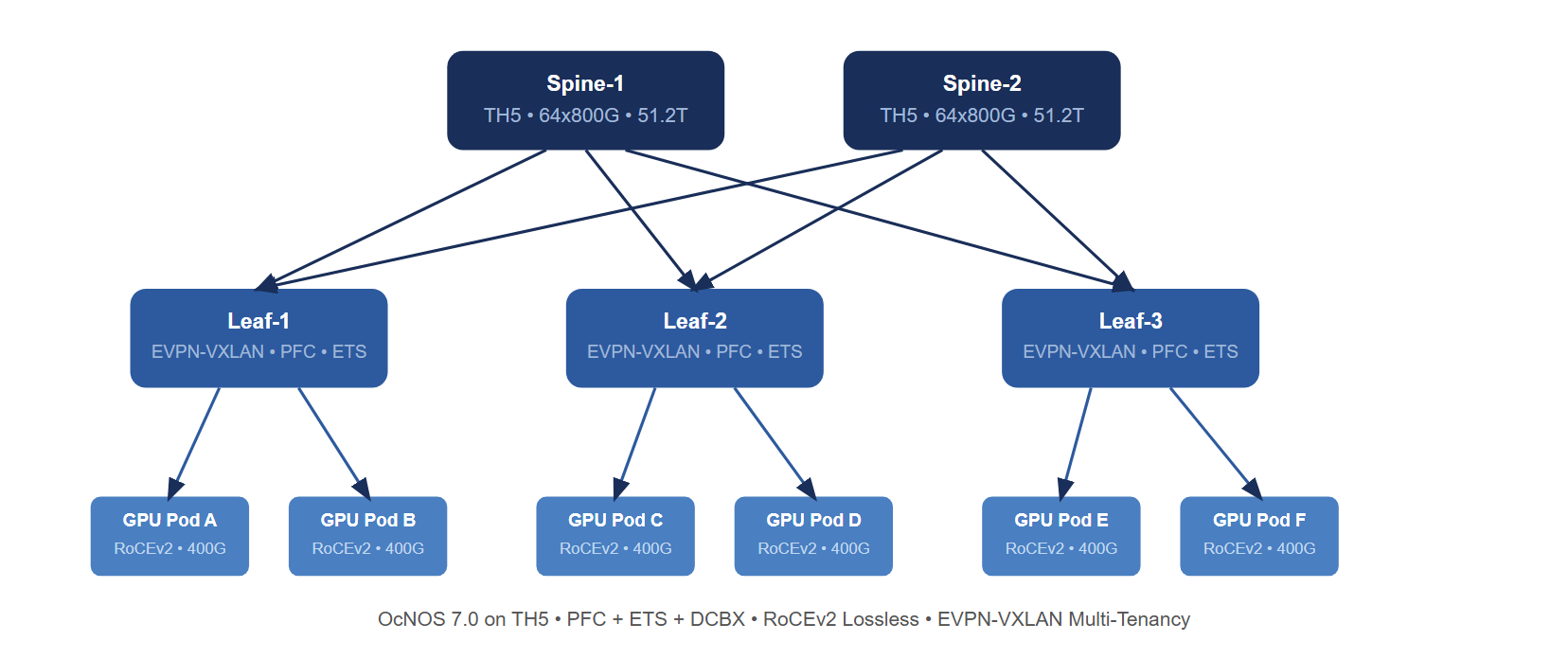
GPU-to-GPU communication in AI training clusters relies on RDMA over Converged Ethernet (RoCEv2). RoCEv2 is highly sensitive to packet loss — even brief congestion events trigger retransmission cycles that stall the entire training job. OcNOS 7.0 delivers a complete lossless fabric solution for RoCEv2 workloads.
Priority-Based Flow Control (PFC) and Enhanced Transmission Selection (ETS)
PFC implements per-priority pause frames, ensuring that a congested queue on a receiving interface signals the sender to stop transmitting for that priority class — preventing packet drops without affecting other traffic classes. ETS allocates bandwidth among traffic classes using weighted scheduling.
! OcNOS 7.0 -- AI fabric: PFC and scheduling
!
configure terminal
qos enable
qos statistics
!
! Step 1: map RoCEv2 traffic (DSCP 24 = CS3) to traffic-class 3
qos profile dscp-to-queue ROCE-MAP
  dscp 24 queue 3
  exit
!
! Step 2: bandwidth allocation
policy-map type queuing default FABRIC-ETS
  class type queuing default q3
    bandwidth percent 70          ! RoCEv2
    exit
  class type queuing default q0
    bandwidth percent 30          ! best-effort
    exit
  exit
!
! Step 3: apply on the fabric port and enable PFC for priority 3
interface cd0
  qos map-profile dscp-to-queue ROCE-MAP
  service-policy type queuing output FABRIC-ETS
  priority-flow-control mode on
  priority-flow-control advertise-local-config
  priority-flow-control enable priority 3
  exit
!
commit
exit
!
! Verification:
show priority-flow-control details all
show priority-flow-control statistics all
show dcbx details interface cd02. EVPN-VXLAN Multi-Site Overlay Extension
Modern data centers are no longer confined to a single location. AI clusters, hybrid cloud architectures, and distributed applications require seamless connectivity across multiple sites without sacrificing tenant isolation or operational control. OcNOS 7.0 delivers EVPN Layer 3 overlay extension with VXLAN stitching between sites, eliminating external gateway appliances and reducing infrastructure cost.
! OcNOS 7.0 -- EVPN-VXLAN L3 overlay, border leaf
!
configure terminal
!
nvo vxlan enable
nvo vxlan vtep-ip-global 10.0.0.1
!
! L3 VNI is configured on the IP VRF
ip vrf TENANT-A
  rd 65001:10001
  route-target both 65001:10001
  l3vni 10001
  exit
!
router bgp 65001
  address-family l2vpn evpn
    neighbor 10.0.0.2 activate              ! site A spine
    neighbor 10.200.0.1 activate            ! site B border leaf
    neighbor 10.200.0.1 route-map EXPORT-SITE-B out
    exit-address-family
  exit
!
! Control which routes extend to the far site
ip extcommunity-list SITE-A permit rt 65001:10001
!
route-map EXPORT-SITE-B permit 10
  match extcommunity SITE-A
  exit
!
commit
exit
!
! Verify:
show bgp l2vpn evpn summary
show bgp l2vpn evpn prefix-route
show evpn l3vni-map
show nvo vxlan tunnel
3. Enhanced Visibility: Selective Mirroring and Route Target Filtering
At scale, operational visibility is not optional. OcNOS 7.0 introduces selective packet mirroring to CPU with filtering, enabling operators to capture and analyze specific traffic flows directly within the fabric — without deploying dedicated capture infrastructure or impacting forwarding performance.
! OcNOS 7.0 -- Selective mirroring for fabric troubleshooting
!
configure terminal
!
monitor session 1 type local
  source interface cd0 rx
  destination interface cd1
  exit
!
commit
exit
!
! Verification:
show monitor session 1
4. New Platform: UfiSpace S9321-64EO (Broadcom Tomahawk 5)
OcNOS 7.0 introduces support for the UfiSpace S9321-64EO — a purpose-built AI fabric switch delivering 51.2 Tbps of switching capacity with 64 high-density OSFP ports at 800G. This platform is engineered for next-generation GPU interconnects and large-scale AI training clusters requiring ultra-low latency and deterministic forwarding.
| 平台 | 芯片 | Switching Capacity | 端口 | 使用案例 |
|---|---|---|---|---|
| UfiSpace S9321-64EO | Broadcom Tomahawk 5 | 51.2 Tbps | 64×800G OSFP | AI spine, GPU fabric |
Key Benefits of OcNOS for Data Centers
- 无损 AI fabric — PFC, ETS, and DCBX deliver RoCEv2 lossless transport without proprietary NICs or switches
- 开放硬件选择 — Broadcom Tomahawk 5 silicon on multiple ODM platforms from UfiSpace, Edgecore, and others
- EVPN-VXLAN multi-tenancy — scalable overlay with Route Target filtering and multi-site L3 extension
- Real-time visibility — on-change gNMI telemetry and selective mirroring for operational insight at scale
- All-inclusive licensing — single SKU covers full OcNOS feature set; no per-feature upsell
- OcNOS 7.0 — Full Release Overview
- OcNOS 7.0 for Service Providers
- OcNOS 功能矩阵
- OcNOS-DC Product Page
- IP Maestro — Element Management for OcNOS
- 联系 IP Infusion
Alan Huang is Senior Product Manager, Data Center at IP Infusion. Connect on LinkedIn.
深入了解,随身带走。
产品数据手册,以及内容比本页更为深入的简明技术下载资料。
OcNOS-DC 数据手册
表单简短。提交后您的 PDF 将立即在新标签页中打开。
✓ 正在新标签页中打开您的 PDF……
如果未能自动打开,请使用下方链接。
OcNOS 800G 无损 AI Fabric
表单简短。提交后您的 PDF 将立即在新标签页中打开。
✓ 正在新标签页中打开您的 PDF……
如果未能自动打开,请使用下方链接。
EVPN-VXLAN 数据中心网络
表单简短。提交后您的 PDF 将立即在新标签页中打开。
✓ 正在新标签页中打开您的 PDF……
如果未能自动打开,请使用下方链接。