Part of IP Infusion's guide to Segment Routing.
In Part 1, we covered Flex-Algo fundamentals and how multiple algorithms coexist in a single IS-IS domain. This article focuses specifically on the TE-metric optimization type, the most common Flex-Algo deployment for separating high-bandwidth bulk traffic from latency-sensitive services.
What is TE-Metric and Why Does it Matter?
Every IS-IS link has two metrics: the IGP metric (used by standard SPF) and the TE metric (used by Traffic Engineering extensions, RFC 3630/5305). These are configured independently, allowing operators to define a completely separate cost structure for TE-based path computation.
A typical deployment assigns:
- IGP metric based on distance or administrative preference (for default routing)
- TE metric based on available bandwidth or congestion cost (for capacity-optimized routing)
When a Flex-Algorithm uses metric-type te-metric, IS-IS runs a separate SPF using TE metrics as link costs. Links with a low TE metric (high available capacity) become preferred, even when their IGP metric is higher. This lets bulk transfer jobs and video streaming traffic follow high-bandwidth paths, while VoIP and 5G control-plane traffic continues on the default IGP shortest path. In the lab shown below, two TE-metric Flex-Algorithms, 130 et 131, are defined side by side, giving two independent TE-metric planes over the same physical topology.
TE-Metric Topology: The 7-Node Lab
The lab is a 7-node IS-IS domain, R1 through R7, running the OcNOS instance OCNOS as a single level-2 area. Every core link carries a per-interface TE metric that is applied only to the IPv4 Flex-Algo topology through isis te-metric flex-algo ipv4 <value>, leaving the plain IGP metric at its default. Because the TE metrics differ from the IGP metrics, the TE-metric SPF for Algorithm 130 and Algorithm 131 can select paths that diverge from the default IGP shortest path across the mesh.
Traffic is placed onto a given algorithm by its per-algorithm prefix-SID, advertised on each router's loopback (for example prefix-sid algorithm-num 130 index 1804 et prefix-sid algorithm-num 131 absolute 17904). Steering therefore relies on the prefix-SID for the chosen algorithm; no separate SR-TE policy is required. R7 raises its Flex-Algo priority to 101 so that it wins the definition election for both algorithms.

Configuration: Flex-Algo with TE-Metric
! OcNOS running-config from R4, a PE router that runs both TE-metric Flex-Algos (130 and 131).
!
! Loopback: default Algo 0 prefix-SID plus a per-algorithm prefix-SID for each Flex-Algo.
R4#show running-config interface loopback1
!
interface loopback1
 ip address 10.10.100.4/32
 prefix-sid index 104
 prefix-sid algorithm-num 130 index 1804
 prefix-sid algorithm-num 131 absolute 17904
 ip router isis OCNOS
!
!
! Core interface: per-link TE metric applied to the IPv4 Flex-Algo topology.
! The plain IGP metric is left at its default; only the te-metric is set here.
R4#show running-config interface cd0
!
interface cd0
 description To-R2-cdo
 load-interval 30
 ip address 10.66.24.4/24
 mtu 9216
 label-switching
 isis network point-to-point
 isis circuit-type level-2-only
 ip router isis OCNOS
 no isis hello padding
 isis te-metric flex-algo ipv4 20
!
!
! Router IS-IS: Flex-Algo 130 and 131 defined, both using metric-type te-metric.
! segment-routing mpls and metric-style wide are configured under router isis.
R4#show running-config router isis
!
router isis OCNOS
 is-type level-2-only
 capability flex-algo routing
 flex-algo 130
  metric-type te-metric
  ti-lfa
 exit-flex-algo
 !
 flex-algo 131
  metric-type te-metric
  ti-lfa
 exit-flex-algo
 !
 metric-style wide
 mpls traffic-eng router-id 10.10.100.4
 mpls traffic-eng level-2
 capability cspf
 dynamic-hostname
 fast-reroute ti-lfa level-2 proto ipv4
 bfd all-interfaces
 net 49.0001.0000.0000.0004.00
 segment-routing mpls
!
!
! On a router intended to win the Flex-Algo election, priority is raised above the
! default of 5. Excerpt transcribed from R7 (default is 5; R7 uses 101).
R7#show running-config router isis
!
router isis OCNOS
 flex-algo 130
  metric-type te-metric
  priority 101
  ti-lfa
 exit-flex-algo
 !
 flex-algo 131
  metric-type te-metric
  priority 101
  ti-lfa
 exit-flex-algo
!Validation: Verifying Algo 130/131 Path Computation
! OcNOS verification commands for the TE-metric Flex-Algos (130 and 131).
! Traffic is steered onto each algorithm by its per-algorithm prefix-SIDs; the
! commands below confirm topology, routes, SR state, forwarding, and data plane.
!
! IS-IS adjacencies
show clns neighbors
!
! Per-algorithm topology (the Metric column reflects the te-metric)
show isis topology algorithm 130
show isis topology algorithm 131
!
! Per-algorithm IS-IS routes
show ip isis route algorithm 131
!
! Segment Routing state and SRGB
show isis segment-routing state
show isis segment-routing capability
!
! Flex-Algo user configuration and election status
show isis flex-algo all status usercfg summary
show isis flex-algo all status usercfg detail
show isis flex-algo all status election summary
!
! IS-IS link-state database
show isis database
!
! MPLS forwarding (FTN) and incoming-label (ILM) tables, per algorithm
show mpls forwarding-table
show mpls forwarding-table algorithm 130
show mpls ilm-table
show mpls ilm-table algorithm 130
!
! TI-LFA backup coverage, per algorithm
show ip isis route tilfa algorithm 131
show isis tilfa pq algorithm 131
!
! Data-plane validation (per-algorithm MPLS ping and trace)
ping mpls isis-sr ipv4 10.10.100.5/32 detail
ping mpls isis-sr ipv4 10.10.100.5/32 algorithm 130 detail
ping mpls isis-sr ipv4 10.10.100.5/32 algorithm 131 detail
trace mpls isis-sr ipv4 10.10.100.5/32 detail- Flex-Algo Part 1: Fundamentals
- Flex-Algo Part 3: Link Delay Optimization
- SR-MPLS Fundamentals
- OcNOS-SP Product Page
- Contacter IP Infusion
IP Infusion Engineering Team
Approfondissez. Emportez-le avec vous.
La fiche technique du produit et des téléchargements techniques et concis qui vont plus loin que cette page.
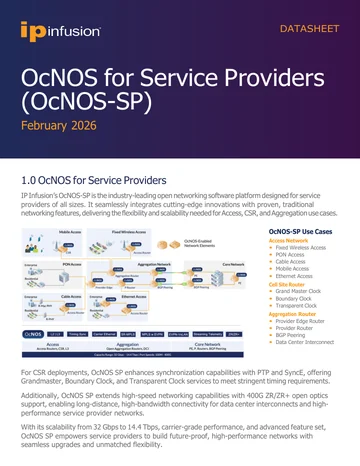
Datasheet OcNOS-SP
Spécification complète OcNOS-SP : l'ensemble des fonctionnalités access, cell site et agrégation, les SKU logiciels, les plateformes matérielles prises en charge et le guide de commande de la solution.
Obtenir la fiche technique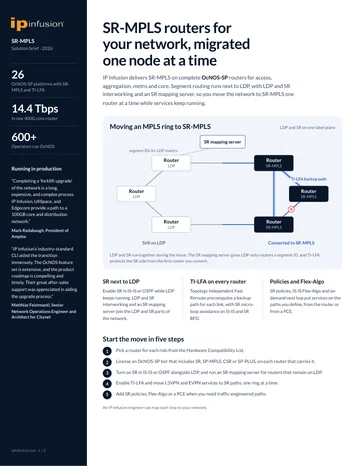
Mise à niveau SR-MPLS avec OcNOS
Migrez SR-MPLS vers OcNOS sur du matériel ouvert : Flex-Algo, TI-LFA et une bascule nœud par nœud.
Obtenir le brief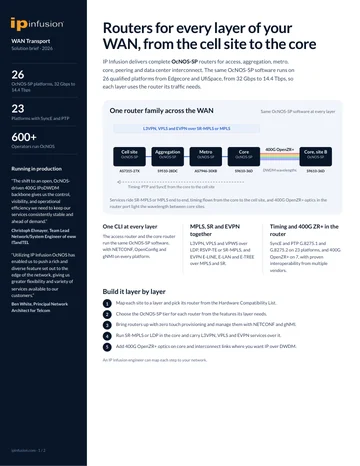
Transport WAN Cloud & Opérateurs
Transport WAN pour le cloud et les service provider sur du matériel ouvert : SR-MPLS, EVPN et transfert testé à l'échelle.
Obtenir le briefDatasheet OcNOS-SP
Formulaire rapide. Votre PDF s'ouvre dans un nouvel onglet immédiatement après l'envoi.
✓ Ouverture de votre PDF dans un nouvel onglet…
S'il ne s'est pas ouvert, utilisez le lien ci-dessous.
Mise à niveau SR-MPLS avec OcNOS
Formulaire rapide. Votre PDF s'ouvre dans un nouvel onglet immédiatement après l'envoi.
✓ Ouverture de votre PDF dans un nouvel onglet…
S'il ne s'est pas ouvert, utilisez le lien ci-dessous.
Transport WAN Cloud & Opérateurs
Formulaire rapide. Votre PDF s'ouvre dans un nouvel onglet immédiatement après l'envoi.
✓ Ouverture de votre PDF dans un nouvel onglet…
S'il ne s'est pas ouvert, utilisez le lien ci-dessous.