TWAMP, Y.1564 and Y.1731: proving SLA on an open network
Carriers sell service-level agreements, then have to prove they are met. OcNOS builds the measurement in: TWAMP for active IP delay, jitter, and loss; Y.1564 to validate a service at turn-up; and Y.1731 Ethernet OAM for continuous per-service delay and loss. No proprietary probe appliances, no timing black boxes.
One service, three measurements
A customer service crosses two OcNOS provider-edge routers over an MPLS or Segment Routing core. The same routers that forward the traffic also measure it: a Y.1564 test proves the service at turn-up, Y.1731 Ethernet OAM watches per-service frame delay and loss between the maintenance end points, and a TWAMP session measures round-trip delay, jitter, and loss inside the routed VPN.
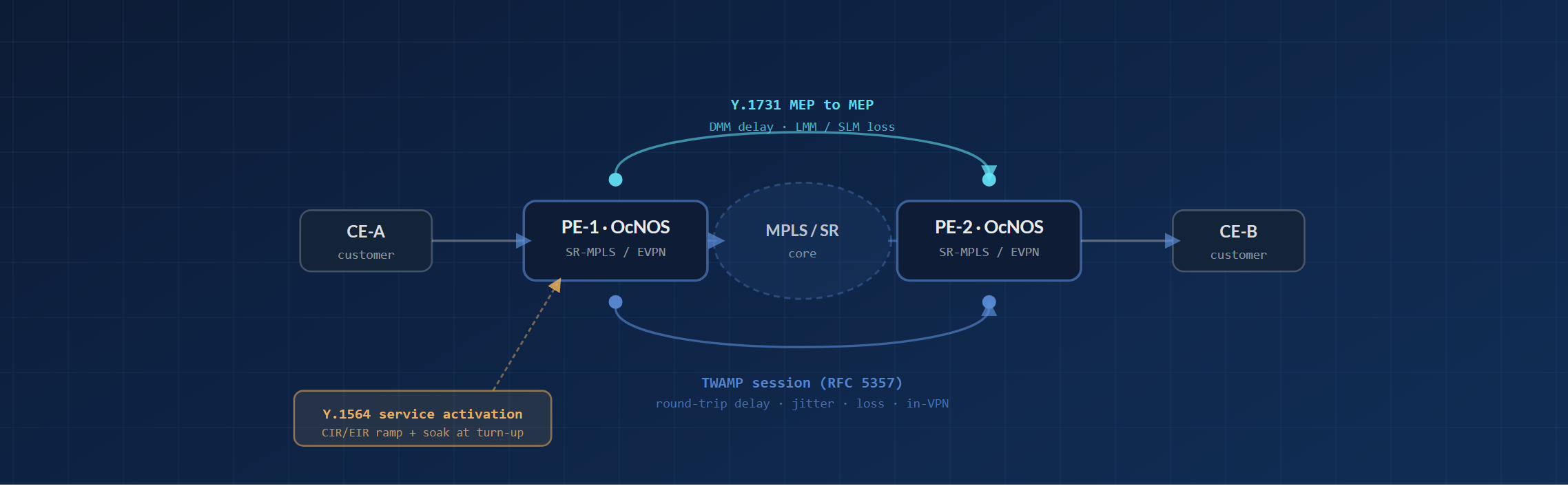
Service assurance answers one operator question: is the path actually delivering what the contract promises? On a closed vendor stack that usually means bolting on a separate probe or a dedicated test head. OcNOS answers it from the router itself, using the three standards network operators already write into their SLAs.
01TWAMP: active IP performance measurement
TWAMP, the Two-Way Active Measurement Protocol (IETF RFC 5357), measures the real performance of a live IP path by sending timestamped test packets between two endpoints and reading the results back. A session-sender originates the test traffic and a session-reflector bounces it, so the sender can compute round-trip delay, delay variation, and packet loss on the exact path a service rides. Because it is an open standard, an OcNOS endpoint interoperates with any conformant TWAMP sender or reflector.
OcNOS implements the full protocol on both sides. A router can be the control-client and session-sender that runs the tests, the server and session-reflector that answers them, or both at once, and it also supports one-way measurement where the metric of interest is one direction only.
What makes this useful for carriers is where OcNOS can run the measurement. TWAMP sessions run over plain MPLS transport and, importantly, inside the customer VPN:
- MPLS L3VPN e EVPN MPLS L3VPN, so the SLA is measured in the same VRF the customer's traffic uses.
- L3VPN over Segment Routing MPLS e L3VPN su SRv6, for operators who have moved transport to SR.
- Inter-VPN access interfaces, to measure across service boundaries.
Measuring inside the VPN matters because a path that looks healthy on the underlay can still miss its SLA for one tenant. TWAMP in the service context measures what the customer actually experiences.
02Y.1564: service activation testing
ITU-T Y.1564, the Service Activation Test (SAT), is run once when a service is turned up, to prove it meets its SLA before the customer is told it is live. It replaces the older RFC 2544 methodology for multi-service Ethernet because it tests all of a service's SLA parameters together rather than one at a time.
A Y.1564 test has two stages. The configuration test ramps traffic through the committed information rate (CIR) and excess information rate (EIR) to confirm the policer and shaper behave as provisioned. The performance test then soaks the service at CIR for a sustained period and verifies the four SLA metrics at once:
- Information rate (throughput at CIR and EIR),
- Frame Loss Ratio (FLR),
- Frame Transfer Delay (FTD),
- Frame Delay Variation (FDV).
OcNOS runs the Y.1564 SAT natively, so a turn-up technician can validate an Ethernet service to its SLA from the OcNOS CLI instead of dispatching a separate test set to each end.
03Y.1731: continuous Ethernet OAM
Where Y.1564 proves a service at birth, ITU-T Y.1731 Ethernet OAM watches it for life. Built on IEEE 802.1ag Connectivity Fault Management, it gives every Ethernet Virtual Connection its own always-on fault detection and performance monitoring. OcNOS implements the full toolkit:
CFM
Connectivity Fault Management with continuity check, loopback, and linktrace across the service, including CFM over layer-2 bridge, provider bridging, VPLS, VPWS, and xConnect.
Frame delay (DMM/DMR)
Frame delay and inter-frame delay variation measured with Delay Measurement Message and reply, per service.
Frame loss (LMM/LMR, SLM/SLR)
Frame loss measured with Loss Measurement and with Synthetic Loss Measurement, which injects synthetic frames to measure loss even on services with no real traffic.
OAM over EVPN
Delay and loss measurement over EVPN MPLS and EVPN VxLAN ELINE and ELAN services, including single-homed and active/active multi-homed attachment.
OAM over protected rings
CFM integrated with G.8032 ring protection (ERPS over CFM) and G.8031 linear protection (ELPS with CFM), so OAM keeps working across a protection switch.
Open and interoperable
Standards-based 802.1ag and Y.1731, so OcNOS OAM interoperates with existing Carrier Ethernet equipment in a multi-vendor metro.
04How the three fit together
The three standards are not alternatives. They are the assurance lifecycle of a service, and OcNOS runs all of them on the same router:
Y.1564
Prove the new service meets throughput, loss, delay, and jitter before it goes live.
Y.1731
Continuously monitor per-service Ethernet delay and loss, and detect connectivity faults, for the life of the EVC.
TWAMP
Actively measure round-trip delay, jitter, and loss inside the routed VPN, across MPLS and SR transport.
Together they let an operator sell a hard SLA and back it with measurement at both the Ethernet and IP layers, on open hardware, without a rack of proprietary probes.
What you get with OcNOS service assurance
Built-in TWAMP, Y.1564, and Y.1731 turn every OcNOS router into its own SLA measurement point. That means faster service turn-up, per-tenant visibility inside the VPN, and SLA evidence you can show a customer, all from the same platform that forwards the traffic and all over standards that interoperate in a multi-vendor network.
Domande frequenti
What is TWAMP?
What is the difference between TWAMP, Y.1564 and Y.1731?
Does OcNOS support both TWAMP client and server?
What is a Y.1564 service activation test?
How does OcNOS measure frame delay and frame loss with Y.1731?
Over which transports can OcNOS run TWAMP?
Building a metro or service-provider network that has to prove its SLA?
Talk to an engineer →Approfondite. Portatelo con voi.
A short, technical download that goes further than this page: the full OcNOS-SP datasheet.
Datasheet OcNOS-SP
Modulo rapido. Il suo PDF si apre in una nuova scheda subito dopo l'invio.
✓ Apertura del suo PDF in una nuova scheda…
Se non si è aperto, utilizzi il link qui sotto.